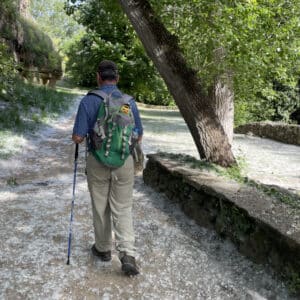
Living in Amsterdam for two years gave us a front‑row seat to a country shaped, down to its bones, by the events of World War II. Still, it wasn’t until our annual Veterans Day tradition rolled around, when we curl up together and pick something WWII themed to watch, that it really clicked. This year, we chose Band of Brothers, and as we made our way through the episodes, we kept pausing the TV and looking at each other. So many of the places mentioned were right there in the Netherlands, towns we hadn’t visited, bridges we’d seen on maps, and names we’d heard our Dutch neighbors speak about with quiet reverence. It was one of those moments when history stops being something in a book and suddenly becomes something alive, something you can stand on, walk through, and maybe even start to understand more fully.
The more we talked, the more we realized we needed to go see these places for ourselves. We’d heard stories from our neighbors about the occupation, the fear their parents and grandparents lived through, and the gratitude they still felt toward the United States for stepping in when things were at their darkest. But watching those scenes unfold on the screen, knowing they played out on Dutch soil, felt like an invitation we couldn’t ignore. So we decided to take advantage of my long Thanksgiving weekend and turn it into a four-day road trip dedicated to visiting WWII sites across the Netherlands. We didn’t know exactly what we’d find or how it would feel, but we knew this trip was going to be something different, something deeper than our usual travels. And we were right.
Remembering History: Why We Started Our WWII Sites Netherlands Road Trip
When we first moved to Amsterdam, we knew the Netherlands had a complicated and painful history during World War II, but we didn’t fully understand it. It came up naturally in conversations with Dutch friends, always gently, always with a kind of generational weight behind it. They would share stories passed down from parents and grandparents about nights spent in fear, about the occupation tightening around everyday life, and about the moment the Americans arrived and everything began to change. Those conversations stuck with us more than we realized at the time.
While watching Band of Brothers on Veterans Day, those stories started echoing in the back of our minds. Here were the very places our friends’ families had described, suddenly alive on the screen with paratroopers dropping from the night sky and soldiers fighting through Dutch towns we knew by name. It created a pull, an almost physical one, that made us want to see these places ourselves. Not out of some historical checklist mindset, but out of a feeling that if we were going to live in the Netherlands, we owed it to the people we’d come to care about to understand better what their families had endured. That’s what set the whole trip in motion: a desire to connect the stories, the places, and the people in a way that made history feel less distant and more human.
Leaving Amsterdam: Train to Schiphol and Picking Up the Rental Car
One thing you learn quickly when living in Amsterdam is that driving in the city is a sport best left to the brave or the unsuspecting tourist. Between the cyclists zipping by with the confidence of fighter pilots and the narrow streets that look charming until you try to get a car down them, it’s usually easier to avoid the whole situation. So for this trip, we did what most locals do: we hopped on the train at Amsterdam Centraal and rode it straight to Schiphol Airport. It’s an easy, no-stress ride, and it dropped us right at the doorstep of the rental car counters.
Picking up the car at Schiphol meant we could start the trip without wrestling our way through Amsterdam’s historic center. Instead, we rolled out of the airport and right onto the highway, feeling that quiet thrill that comes with starting a road trip. There’s something freeing about pulling away from the airport with a wide-open weekend ahead of you, no obligations, no work calls, just the two of us, a small suitcase, and a route pieced together from history books, museum maps, and moments from a television series that had unexpectedly pulled us back in time. Our first destination: the Nationaal Militair Museum in Soesterberg, a place we’d been meaning to visit but had somehow never gotten around to. Now it was finally on the docket.
Exploring the Nationaal Militair Museum (Soesterberg)
The Nationaal Militair Museum in Soesterberg isn’t the kind of place you can breeze through. It’s vast, spread across a former airbase, and it manages to strike that perfect balance between offering you the big, sweeping history of the Dutch armed forces and immersing you in the stories of the people who actually lived it. We walked through the doors expecting something interesting, but not necessarily surprising. Instead, we were hit with a museum that’s beautifully curated, deeply thoughtful, and honestly one of the most impressive military museums we’ve ever stepped into.
Inside, the first thing you notice is the sheer size of the collection. Fighter jets, helicopters, tanks, and armored vehicles fill the main hall, each one displayed in a way that lets you get up close without feeling crowded. There are interactive exhibits, historical artifacts going back centuries, and multimedia displays that make it easy to follow the Netherlands’ long and complex military history. Outside, we wandered the old airfield paths surrounded by retired aircraft and open-air exhibits. It felt like walking through layers of time, one moment looking at medieval armor, the next staring into the cockpit of an F-16. We spent hours here without even realizing it, learning more about the country we’d called home for two years than we ever expected during a casual museum visit. This place became the perfect starting point for our WWII journey, setting the tone for everything we’d encounter over the next few days.
Castle Helmond: History in the Heart of a Small Dutch Town
Leaving Soesterberg behind, we drove south toward Helmond. Right in the center of town sits Castle Helmond, a striking medieval fortress that feels almost surreal when you first see it. Surrounded by water and tucked neatly into a modern cityscape, it’s the kind of place that reminds you just how old and layered Dutch history really is. Built in the 14th century, the castle has served as a noble residence, a defensive stronghold, and even a part of the region’s industrial past. Today it operates as a museum, offering a look at everything from medieval life to Helmond’s evolution through the centuries.
Inside, the castle blends atmosphere with storytelling in a way that kept both of us engaged the whole time. Thick walls, winding staircases, furnished rooms, and well-curated exhibits paint a vivid picture of life across different eras. We took our time wandering through, reading the placards, and admiring the architecture that somehow feels both imposing and cozy. Once we stepped back outside, downtown Helmond pulled us in without even trying. It’s one of those unexpected little Dutch towns with narrow streets, inviting shopfronts, and a sense of calm that makes you want to linger. We strolled past small boutiques, watched locals biking home from work, and admired the canals reflecting the soft afternoon light. It wasn’t part of the WWII itinerary, but it turned out to be one of those small, sweet moments that make a trip feel fuller.
Thanksgiving in Eindhoven: A Memory We Still Laugh About
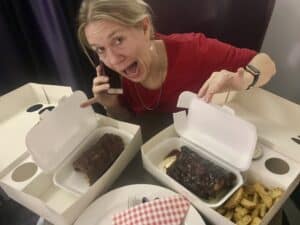
By the time we rolled into Eindhoven that evening, the sky had already slipped into that soft Dutch twilight where everything looks a little silver. It also happened to be Thanksgiving back in the U.S., which hit Laura harder than she expected. She called her parents as soon as we checked in, and while her mom bustled around the kitchen preparing the big family feast, I could hear that little tremble in Laura’s voice, the one that always shows up when she’s missing home more than she wants to admit. Holidays away from family have a way of sneaking up on you, even when you’ve been living abroad for a while.
While Laura caught up with everyone back in Texas, I slipped downstairs to ask the concierge if there was any chance, any at all, that I could find a turkey dinner somewhere in the city. He made several calls, each more doubtful than the last. The closest thing we could piece together was… well, not turkey. But he did manage to find a place willing to deliver a massive order of BBQ ribs with all the trimmings. Not exactly a traditional Thanksgiving meal, but it turned out to be perfect. When the bags arrived and I laid everything out with a bottle of red wine and the hotel’s famously tiny plastic cups, Laura broke into the biggest grin. Her family howled with laughter over the phone and insisted they would gladly trade their turkey for ribs any year.
After our unorthodox Thanksgiving feast, we bundled up and headed out for a slow walk through downtown Eindhoven. The city was already dressed for Christmas, strings of warm lights overhead, decorated trees in the plazas, and the kind of storefront displays that make you feel like you’ve stepped into a holiday postcard. People were out enjoying the evening, the air smelled faintly of roasted nuts from a nearby stall, and for that little stretch of time, it felt like the whole trip had shifted into something warm and unexpectedly special. It wasn’t the Thanksgiving we grew up with, but it became one of the ones we’ll never forget.
Heading North: Breakfast in Overloon and the Overloon War Museum
The next morning, we were up early, eager to cover some ground. We drove out of Eindhoven while the city was still waking up and made our way to Overloon, a quiet town that carries a heavy piece of WWII history. We grabbed a simple Dutch breakfast, coffee and tea, and a couple of warm toasty sandwiches (the Dutch version of a grilled ham-and-cheese), before heading straight to the Overloon War Museum. We’d heard good things, but nothing prepared us for the scale or emotional weight of what we were about to walk into.
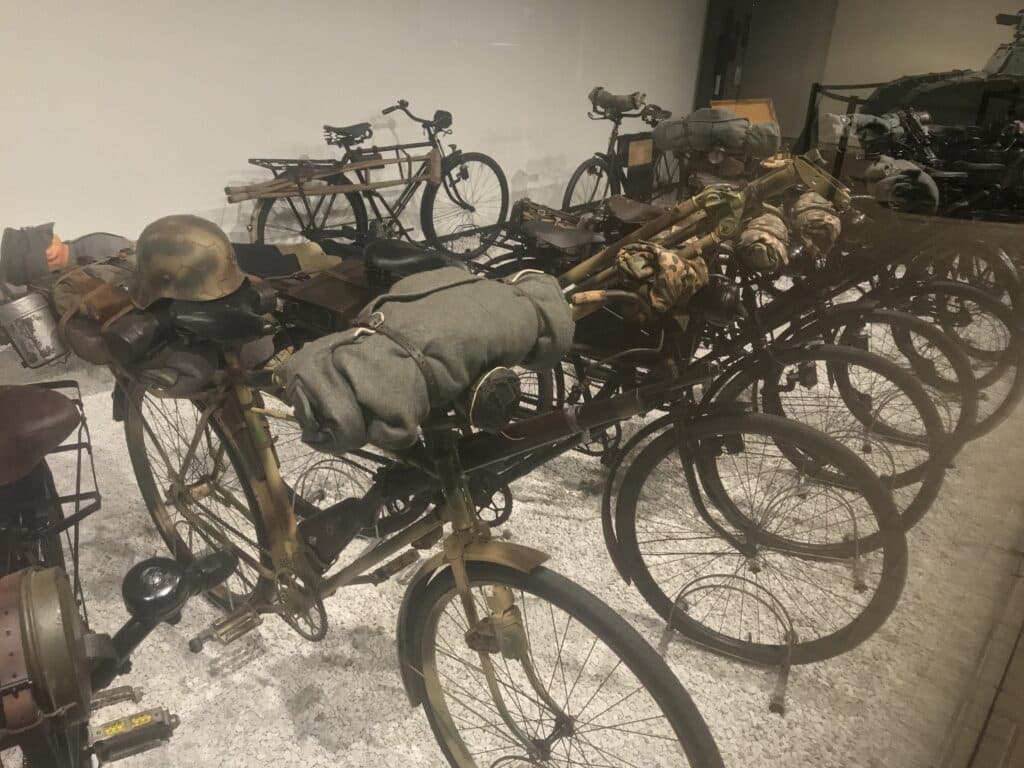
The Overloon War Museum is one of the largest WWII museums in the Netherlands and sits on the site of the Battle of Overloon, an intense and destructive battle in 1944. Inside, the museum is packed with tanks, vehicles, weapons, uniforms, and artifacts that trace the story of how the war unfolded across Dutch soil. But it wasn’t just the displays that stayed with us; it was the details. We were both stunned to learn that the Dutch Army entered WWII with bicycles as their primary mode of transportation. Seeing rows of those wartime bikes positioned next to massive German tanks drives home the impossible odds the Dutch faced in those early days.
What struck us even more was the unmistakable gratitude woven into the exhibits, photos, letters, displays, and stories expressing genuine appreciation for the U.S. role in liberating the Netherlands. We’d heard our Dutch neighbors speak about this with quiet respect, but standing there, surrounded by artifacts of destruction and survival, made it much more real. We spent hours slowly moving through each section, often in silence, taking it all in. Overloon set the emotional tone for the day: thoughtful, heavy, and deeply grounding. It reminded us that history isn’t just facts, it’s lives disrupted, families fractured, and communities rebuilt from the ground up.
Quiet Reflection: The Overloon War Cemetery
Leaving the museum, we made a short stop at the Overloon War Cemetery, a peaceful but solemn place that feels worlds away from the armored vehicles and battle artifacts just down the road. The cemetery is impeccably maintained with rows of white headstones aligned with almost mathematical precision, each marking a young life that never made it home. There’s a stillness there that settles over you the moment you step onto the grounds, the quiet that encourages reflection rather than conversation.
Strolling between the graves, we found ourselves absorbing the weight of what the museum had introduced. The names, ages, and regiments etched into the stones bring the scale of WWII back down to something painfully personal. Many of these soldiers died during liberation efforts in the region, and standing there, surrounded by so many markers in such a small space, made the cost of those operations unmistakably real. We didn’t linger long; some places ask for a quiet visit rather than a drawn-out stay, but those few minutes stayed with us for the rest of the trip. It felt like the emotional hinge between the history we’d learned and the history we were about to drive deeper into.
Operation Market Garden Sites: Driving Through History
Leaving Overloon behind, we followed a scenic route toward the town of Grave, where one of the pivotal actions of Operation Market Garden unfolded. Even before we reached the bridge, the landscape itself seemed to shift, flat fields stretching to the horizon, narrow roads tracing old farm boundaries, and small villages that still carry hints of the war in their layout. Our goal was to cross the John S. Thompson Bridge, once known simply as the Maas Bridge, which the 504th Parachute Infantry Regiment captured during Market Garden. Driving across it today, it’s just another Dutch bridge, quiet, functional, unassuming, but knowing what happened there changes the entire experience. For us, it felt like rolling over a piece of living history.
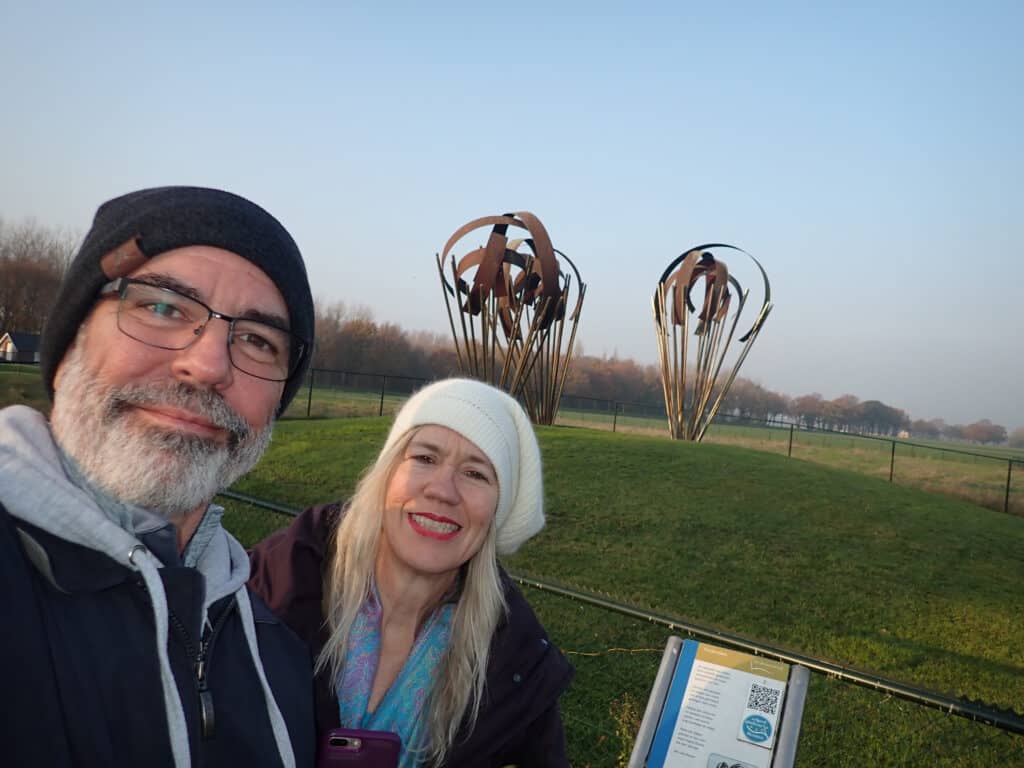
A few minutes outside of Grave, we stopped at the 82nd Airborne Division Memorial. It’s a small roadside monument, easy to miss if you’re not looking for it, but standing there brings a surprising sense of connection to the paratroopers who dropped into these fields in 1944. From there, we continued to the Waco CG-4A Glider Memorial near Wolfheze. If you’re not familiar with WWII gliders, they were essentially oversized plywood aircraft towed behind bombers and cut loose to land troops and equipment behind enemy lines. Seeing the memorial here, in the quiet countryside where so many gliders crash-landed, was a stark reminder of how risky and chaotic the entire operation was.
A Quick Look Back: What Was Operation Market Garden?
Operation Market Garden was an ambitious Allied plan launched in September 1944, intended to secure a series of key bridges across the Netherlands and open a rapid path into Germany. “Market” referred to the airborne operations, paratroopers, and glider troops securing the bridges, while “Garden” covered the ground forces pushing north to link up with them. It was bold, daring, and ultimately unsuccessful. One bridge too many was lost at Arnhem, and the failure there halted the offensive. But the bravery of the airborne units and the Dutch civilians who supported them remains one of the most compelling stories of the war.
Driving between these sites, it was impossible not to feel humbled. These quiet roads were once the backdrop of one of the war’s most daring and tragic operations. Seeing them with our own eyes connected the dots in a way no book or documentary ever could.
Vrijheidsmuseum (Freedom Museum) – Groesbeek
Our next stop brought us to the Vrijheidsmuseum, set just outside Groesbeek on gently rolling hills that played a significant role during the final phases of WWII. The museum itself is hard to miss; its dome-shaped structure sits boldly in the landscape, almost like a beacon calling attention to the stories held inside. Once we stepped through the doors, it became clear this wasn’t just another museum; it’s a place designed to make you think, connect the dots, and understand both the cost of war and the fragile value of freedom.
The exhibits here walk you through the history of the Netherlands before, during, and after WWII, with a special emphasis on Operation Market Garden and the liberation of the surrounding region. Interactive displays, personal accounts, photographs, and artifacts create a thoughtful progression that helps you see the war not only through military movements but also through the eyes of civilians who lived through it. It’s the kind of museum where you find yourself slowing down, rereading plaques, and absorbing the context piece by piece.
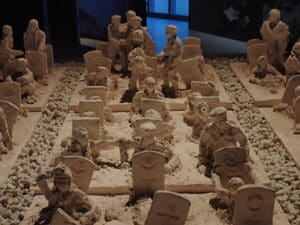
One of the most moving parts of the museum is the sculpture De Bevrijders, “The Liberators.” It depicts fallen soldiers rising from their graves to greet each other, a moment caught somewhere between grief and relief. Standing in front of it is a quiet punch to the chest. It’s haunting, beautiful, and humbling all at once. We lingered there longer than we expected, letting the symbolism settle in before continuing through the rest of the exhibits.
By the time we stepped back outside, the sun was dipping low, casting long shadows across the museum grounds. It felt like the right moment to wrap up the day and continue toward Arnhem, knowing we had seen something important, something that deepened our understanding of what liberation truly meant for this part of the world.
Arriving in Arnhem: Crossing the John Frost Bridge
As we continued our drive toward Arnhem, the sky shifted into that soft late‑afternoon glow the Netherlands does so well, gold at the horizon, pale blue overhead, and a kind of calm that settles over the landscape. Just before reaching the city, we crossed the John Frost Bridge, and even though it’s a regular commuter route today, the weight of its history hangs over it the moment you know what happened there. This is the bridge made famous by the film A Bridge Too Far, the very spot where British paratroopers held out far longer than anyone thought possible during Operation Market Garden.
The bridge is named after Major-General John Dutton Frost, who led the 2nd Parachute Battalion in the effort to seize and hold it. Their stand at the northern end of the bridge became one of the defining moments of the entire operation, heroic, desperate, and ultimately doomed because reinforcements never made it through. Standing on that bridge today, it’s impossible not to picture what it must have looked like in 1944: smoke, rubble, gunfire echoing through the city streets, and a small band of exhausted soldiers trying to hold back overwhelming German forces.
It was this battle that led Field Marshal Bernard Montgomery to admit later that Market Garden had been “one bridge too far”, a phrase that became the title of the book and the film “A Bridge Too Far”, which popularized the story for generations after the war. Driving across that span, with modern trams rolling beneath and cyclists breezing past us, we felt the strange duality that defines so many WWII sites in the Netherlands. Life moves on, cities rebuild, but the memory remains, quiet, persistent, and woven into the identity of the places themselves.
We crossed into Arnhem just as evening settled in and found dinner before checking into our hotel for the night. It had been a long day, but one filled with the kind of history that stays with you long after the drive is over.
Museum Het Valkhof – Nijmegen
The following morning, we made our way to Nijmegen, one of the oldest cities in the Netherlands and another key location in Operation Market Garden. Before heading into the museum, we stumbled upon a small street market setting up for the day, rows of vendors assembling their stalls, the smell of fresh bread drifting through the air, and the sound of early shoppers greeting each other as it was a weekly ritual. We grabbed a quick bite and soaked in the atmosphere before heading into Museum Het Valkhof.
The museum sits near the site of ancient Roman encampments, and the collection reflects that deep historical layering. Inside, we found everything from Roman artifacts to medieval objects to modern exhibits that tie Nijmegen’s long story together. What surprised us most was how seamlessly the museum blends archaeology and art, giving you a sense of place that stretches far beyond the WWII focus of our trip. It’s the kind of museum where you wander from room to room, feeling like you’re time-traveling.
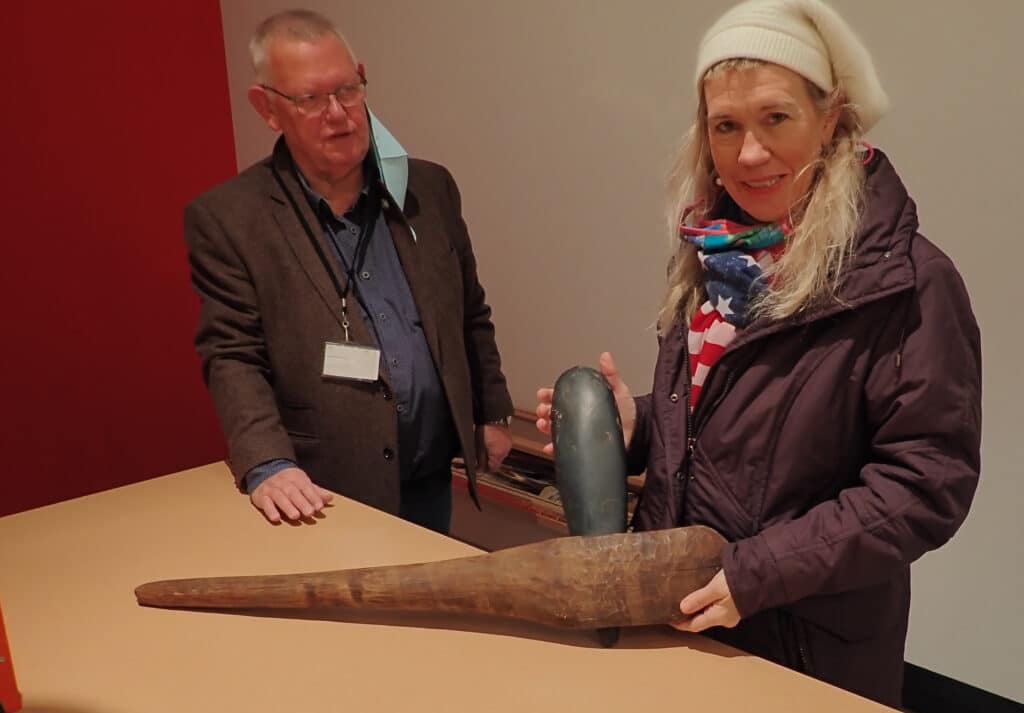
One of the highlights, and definitely one of the more unexpected moments of the entire trip, came during a special add-on we purchased: the children’s basement tour. I signed us up mostly because Laura is a child at heart, and I knew she’d appreciate the whimsy of it. As it turned out, the curator leading the tour was delighted that two adults had joined in, and he brought out something truly remarkable: a Neolithic polished stone axe, dating back somewhere between 4000 and 2500 BC. When he placed it carefully in Laura’s hands, she froze for a moment, eyes wide.
There’s something surreal about holding an object that predates written language, the Roman Empire, and nearly every structure still standing in Europe. It felt like the axe carried the echo of thousands of years, of people living, building, struggling, and thriving long before the turmoil of WWII ever touched this region. That small moment turned out to be one of the most memorable of our entire trip, a reminder that history isn’t just one story, it’s layers upon layers, all connected in ways we don’t always expect.
The Airborne Museum at Hartenstein
From Nijmegen, we drove toward Oosterbeek to visit the Airborne Museum at Hartenstein, one of the most important WWII sites in the entire Netherlands. The museum is housed inside the former Hotel Hartenstein, which served as the British headquarters during the Battle of Arnhem. Walking up to the building, it looks peaceful and stately now, surrounded by trees and quiet streets. Still, during September 1944, this was the epicenter of desperate fighting, radio calls, dwindling supplies, and some of the most courageous defensive actions of Operation Market Garden.
Inside, the museum does an exceptional job of pulling you into the story. Exhibits recount the airborne landings, the confusion of the scattered drops, and the chaotic battles that unfolded throughout Oosterbeek and Arnhem. Maps, uniforms, personal belongings, and first-hand accounts help paint a picture of what it took for British paratroopers to hold their ground even as the situation deteriorated. The most immersive part is the “Airborne Experience,” a multimedia walkthrough that simulates what soldiers and civilians faced in those final days, explosions echoing, rubble surrounding you, and the eerie sense of uncertainty that defined the battle.
A small but memorable discovery happened here as well: this was the first time we learned about Watership Down. One of the museum’s displays mentioned that Richard Adams, the author of the book, served with the British Army during WWII and later fought in the Battle of Oosterbeek. That connection caught our attention, and after the trip, we ended up reading the novel together. Knowing that Adams carried the memories of this battle with him as he wrote gave the book a depth we wouldn’t have appreciated otherwise. It’s funny how travel works: you set out to learn one thing, and you end up discovering a dozen unexpected connections along the way.
By the time we stepped back outside, the late-afternoon light had settled over Oosterbeek, casting long shadows through the trees. We drove back to Arnhem for dinner and a quiet evening walk, both of us feeling the weight of the stories we’d absorbed and grateful for the chance to walk through a piece of history that had shaped not just the Netherlands, but the world.
A Slow Sunday: Visiting the Arnhem Aardvark Park
By our last morning, we were ready to slow the pace a little. After several days packed with museums, memorials, and emotional history, a quiet Sunday felt like the right way to close out the trip. Before leaving Arnhem, we stopped at the Arnhem Aardvark Park, a small, quirky green space that had popped up on our map the night before. With a name like that, how could we not go?
The park turned out to be exactly what we needed, simple, peaceful, and unexpectedly whimsical. Right in the middle of it stands a giant aardvark-themed playscape, complete with climbing structures, tunnels, and bright colors that make it look like something out of a storybook. Even without kids in tow, we couldn’t help but wander over for a closer look. Families were already out enjoying it, children scrambling over the aardvark’s belly while parents sipped coffee nearby. After several days immersed in the intensity of WWII history, standing in a park anchored by a giant friendly aardvark felt grounding, almost restorative. It was a reminder that places can carry deep scars and still grow into somewhere calm, beautiful, and full of everyday moments.
We didn’t stay long, just enough to appreciate the quiet before grabbing coffee and tea for the road and starting our drive back toward Amsterdam. The park wasn’t a grand finale, but it didn’t need to be. It was a soft landing after a powerful journey through history, and it gave us a few moments to catch our breath and take in everything we’d seen.
Reflections on Our WWII Sites Netherlands Road Trip
Driving back toward Amsterdam, we found ourselves replaying the trip in quiet moments, the museums, the memorials, the bridges, the fields, the stories that stretched far beyond anything we’d absorbed in books or films. Before this trip, we had a solid understanding of WWII. We knew the broad strokes, the turning points, the human cost. But walking the ground where it all happened changed something in us. Standing in cemeteries where thousands of young men are buried, crossing bridges that determined the fate of entire regions, and listening to the echoes of stories told by Dutch families, it all made the war feel heartbreakingly real.
Traveling for fun is one thing, but traveling with purpose is something else entirely. We’ve always believed that part of exploring the world is taking the time to understand the history beneath your feet. This trip taught us that in a profound way. This small country endured occupation, starvation, and devastation, yet its people rebuilt with resilience and gratitude that still shows today. Seeing the gratitude toward the U.S. displayed so openly in museums and memorials moved us more than we expected.
As we pulled into Amsterdam and returned the rental car, we both felt a deeper appreciation for the freedom we often take for granted. WWII claimed roughly 85 million lives, around three percent of the world’s population at the time. That number is so large that it becomes almost impossible to imagine. But when you’re standing at places like Overloon, Arnhem, or Groesbeek, the scale narrows to something human. It becomes names, faces, stories, sacrifices.
If there’s one thing this trip reinforced, it’s that remembering the past isn’t just an academic exercise; it’s a responsibility. The Greatest Generation endured horrors we can scarcely fathom, and the liberties they fought for can only be honored by protecting them for future generations.
We hope that wherever your travels take you, you’ll make time to explore the history woven into the landscape. It doesn’t have to be heavy or overwhelming; it just has to be honest. Travel may be about seeing beautiful places, but it’s also about gaining perspective, recognizing the cost of the freedoms we enjoy and the courage of those who secured them. And sometimes, the most unexpected journeys become the ones that change us the most.

After a journey like this, it’s hard not to feel changed in some small but permanent way. The original reflections we shared above speak to the emotional weight of walking through these historic places, but there’s also an invitation tucked inside those experiences. History only lives on when we choose to remember it, engage with it, and pass it on. And travel, as simple as it may seem, is one of the most meaningful ways to do that.
If you’ve been thinking about exploring WWII sites or any historic places that speak to you, we hope this encourages you to start planning. You don’t need to map out every detail or wait for the perfect moment. Just pick a place, carve out a day or two, and let curiosity lead you. You might be surprised by what you learn, who you meet, or how the story stays with you long after you’re home.
Before you go, we’d genuinely love to hear from you. Have you visited sites that left a deeper mark than you expected? Do you have places on your list that you’re hoping to explore? Share your thoughts, questions, or stories in the comments; we read every one. And if you enjoy following along with our travels and want more guides, stories, and senior-friendly adventure tips, let us know. We’d be honored to have you follow along as we keep exploring the world, one meaningful journey at a time.