
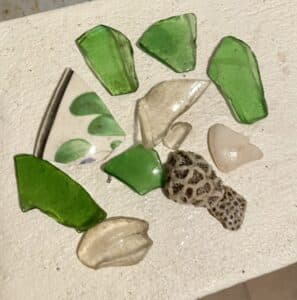
I was wandering along the beach in St. Vincent that Thursday morning, happily lost in my sea-glass hunt, while Philip waited with the kind of patience only a seasoned travel partner develops. The tide had carved out a thin ribbon of water in the sand, nothing dramatic, just one of those channels you step over without a second thought. I moved up to the wetter part of the beach to cross, and he went straight for the channel. That’s when everything shifted. Literally, one moment he was stepping forward, and the next, the sand beneath him just collapsed.
It wasn’t a dramatic fall, no crashing or shouting, just this slow, awful twist as the sand gave way and sent him turning to the side. I knew immediately it wasn’t good. He tried to get up, putting weight on his right ankle, and it was like the ground disappeared again. A couple of guys who had been filming from the overlook saw the whole thing and ran down to help. They got him to a set of stone steps, and we just sat there catching our breath and pretending this was all fine. He kept insisting nothing was broken, but even then, I had a sinking feeling that our dive plans were about to change.
The Ankle Incident That Changed Our Scuba Diving Travel Story
Watching someone you love try and fail to put weight on a leg is a special kind of sick feeling. He kept saying it was “just a tweak,” but that ankle wasn’t listening to him at all. As he rested there, trying to play tough, I could read the writing on the wall: our week of diving had just been rewritten by the island, whether we liked it or not.
We eventually hobbled back, slow and stubborn, still hoping maybe nothing was seriously wrong. But after watching him limp around that afternoon, we made the call: no scuba diving for at least a week. Not exactly the plot twist we wanted, but travel doesn’t always ask for permission before reshuffling your plans.
Adjusting Plans and Heading to Barbados
By the time we boarded our flight to Barbados, we had entirely accepted that our scuba diving travel story for this trip was going to look very different from what we’d planned. His ankle was still tender and unwilling to cooperate, so we agreed he needed to sit out any diving until it proved it could handle the strain. As much as he hated it, I reminded him that it’s better to miss a few dives than risk a real injury that could sideline us for months. He grumbled, but he knew I was right.
When we checked in with the dive operation we had previously booked and paid for, the reaction to our sudden change of plans was… let’s say less than enthusiastic. They were willing to refund half his dives (one of the two days), but not mine. Standing there, trying to explain his ankle and why we weren’t sure about diving, I felt this awkward pit forming in my stomach. I’d never gone diving without him, not once, and now I was suddenly considering it.
After a moment of quiet thinking (and maybe a slight panic), I finally said out loud what had been swirling in my head: this might be a good chance for me to see if I could dive on my own. Their response was instant enthusiasm, which made me laugh a little. I wasn’t entirely confident yet, but the idea stuck. If our story was going to take a twist, maybe I could lean into it instead of resisting.
Stepping Into My First Solo Dive
I didn’t sleep well the night before my first dive without him, not because I was scared, but because it felt strange stepping into a part of our scuba-diving travel story alone. Diving has always been something we shared, something we did side by side from the moment I signed up for lessons (he had been diving for years before I joined him). Waking up that morning, knowing I’d be gearing up without his quiet commentary and double-checks, left me feeling a mix of nerves and determination.
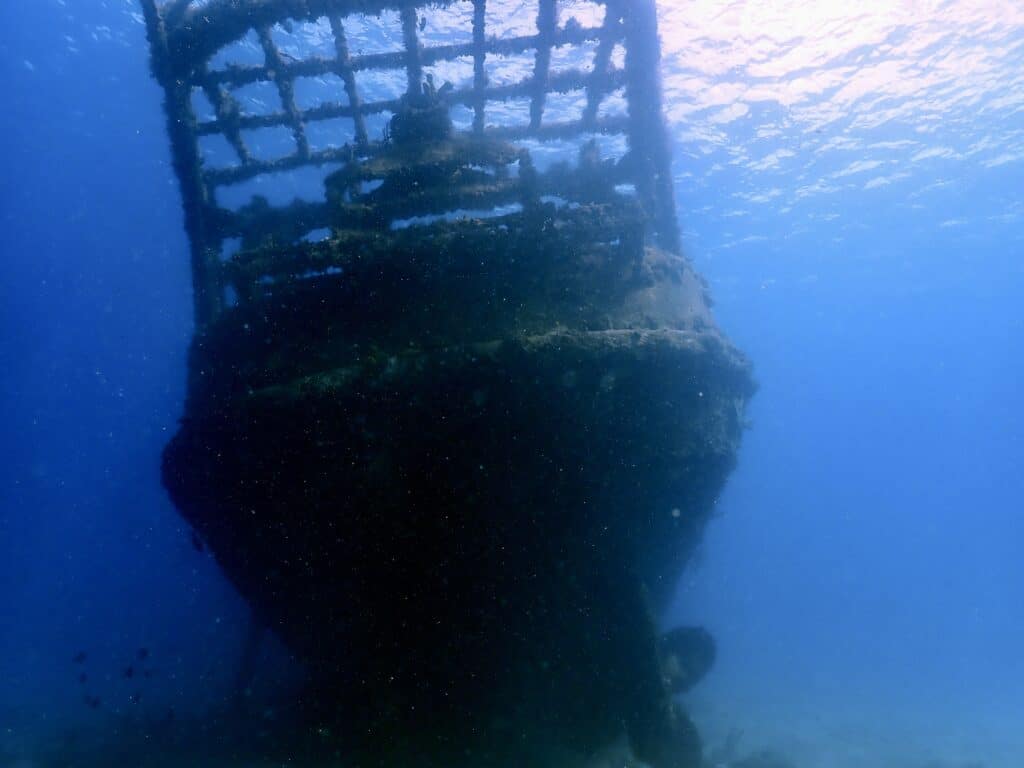
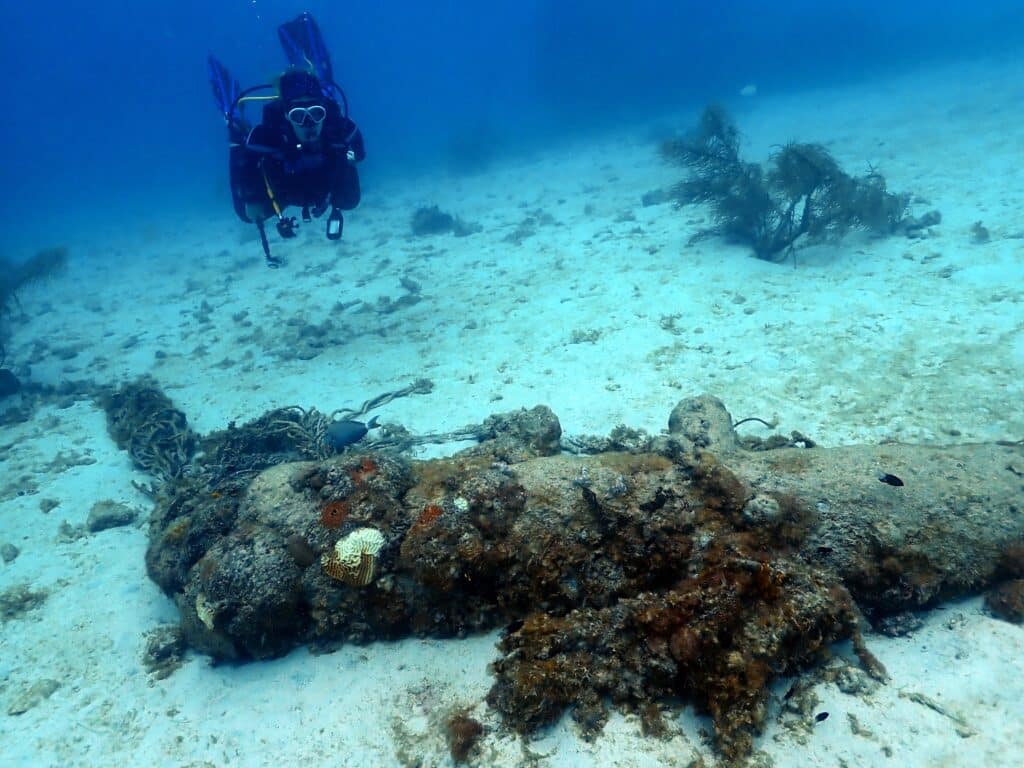
The crew that morning was a mixed bag. The boat captain gave us a quick rundown, though he seemed only half invested. The dive guide, on the other hand, was cautious about the conditions. The waves were choppy enough that he changed the plan on the fly, moving us to a wreck that sat around 80 feet at the bottom and rose to about 50. I was relieved, honestly. A deeper dive might’ve been too much for my first one alone.
There was a newer diver with us, a confident Canadian woman who had done her first ocean dive only the day before. She reminded me of myself a few years ago: excited, eager, and carrying just enough healthy respect for the ocean to stay out of trouble. Watching her handle the pre-dive made me smile. The wreck itself was impressive, but we spent a long time circling it, long enough that my mind began wandering. Maybe this was the universe’s way of nudging me into a new chapter of this trip, whether I felt ready or not.
A Chaotic Turn in Carlisle Bay
If the first dive felt like easing into this new chapter of my scuba diving travel story, the second dive at Carlisle Bay felt like being tossed into the deep end, figuratively and literally. Carlisle Bay is busy on a good day, but that morning it was downright chaotic. Boats racing back and forth everywhere, cruise passengers bobbing around without fins (apparently that’s a thing there), and our little dive group trying to carve out a quiet corner of underwater calm only 45 feet below the chaos!
During our short surface interval, I started switching out my tank, expecting the usual level of help you get on most dive boats. But on this one, the system was basically do-it-yourself with a sprinkle of “good luck.” While assembling my gear, I noticed a soft hiss of air, nothing dramatic at first, but enough to raise an eyebrow. I tried to remove the first stage to check the O-ring, but it was too tight to remove (I had forgotten to turn the air off… rookie mistake), so I asked for help.
The dive guide stepped in to help, turned the air off, made an adjustment, turned it back on… and the plastic knob on the tank fell off! Just plunked right into his hand. We both paused, staring at it as it had betrayed us. He shrugged and said I’d be fine for the dive, which did not inspire the confidence he probably hoped it would.
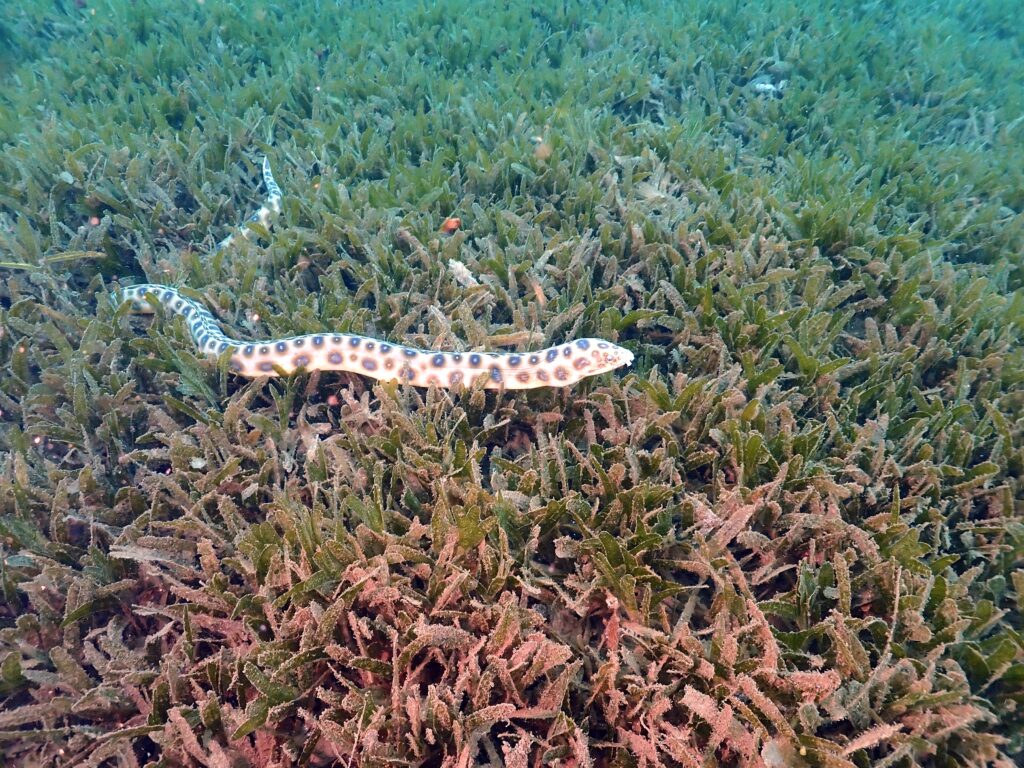
Still, I took a steadying breath, reminded myself I wasn’t new to this, and followed the group in. We had a long surface swim through the mooring field toward several small wrecks. I stuck close to the newer diver as we’d formed an easy rapport. Once we descended, I even saw a beautiful spotted snake eel weaving beneath her, one of those tiny moments that make diving worth every bit of chaos.
But then the hissing in my ear grew louder… much louder. I know a worn and leaking O-ring usually sounds louder underwater, but this was something else. That’s when my instincts flipped from curious to concerned. I made the call in a split second: swim hard to the dive guide, grab his fin if I had to, and get his attention before the situation got worse.
When a Scuba Diving Travel Story Becomes an Underwater Emergency
The moment I reached the guide, I yanked gently but firmly on his fin, hard enough that he spun around, eyes wide. I pointed straight to my first stage, and he checked my gauge immediately. The look on his face was enough to tell me this wasn’t just a minor inconvenience. My air was dropping fast. Much faster than it should have been. After only five minutes of diving, I was down to 2200 PSI (almost 1/3 of my air was gone).
We began a controlled ascent together while the rest of the group followed, staying close, me gripping his arm and him keeping his eyes locked on both our gauges. Watching the numbers fall was surreal: 2000, 1800, 1500, 1200. Every diver knows that sinking feeling when your PSI drops faster than your brain can process. Even with experience, it’s jarring when the situation shifts from “this is fine” to “we need to handle this now!”
At about fifteen feet, he signaled a safety stop. I hesitated. A safety stop made sense in theory, and I trusted his judgment, but I also knew the line between calm and crisis was thin. I told myself that if I hit 300 PSI, I was taking his alternate air source or heading up. Thankfully, it didn’t come to that. By the time we surfaced, I had around 500 remaining, still far from my comfort zone, but enough to keep the panic at bay.
Then came the long surface swim, twenty minutes of kicking through the chop while calling for the boat to move towards us. When we finally reached it, we found the captain… napping! The guide found a spare tank, and we started troubleshooting. I covered the edge of my 1st stage with my thumb, and the hissing stopped instantly. But the captain insisted it wasn’t the O-ring, repeating it like a mantra, he kept saying my 1st stage was defective. It didn’t matter. The moment the guide wiggled the first stage and the leak changed, I knew I wasn’t wrong.
Still, I shrugged it off; no point arguing on a dive boat. I geared up again, skipped grabbing my GoPro this time, and slipped back into the water for what turned out to be the calmest dive of the day. Almost peaceful. Almost.
A Calm Third Dive and Some Tough Reflections
Sliding back into the water for the third dive (which was actually the second half of the second dive) felt strangely grounding after everything that had just happened. Without my GoPro in hand, I realized how much more present I felt. No fiddling with camera buttons, no checking angles, just me, my breath, and the steady rhythm of the ocean. For a moment, it felt like the kind of peaceful note every scuba diving travel story hopes to hit at least once.
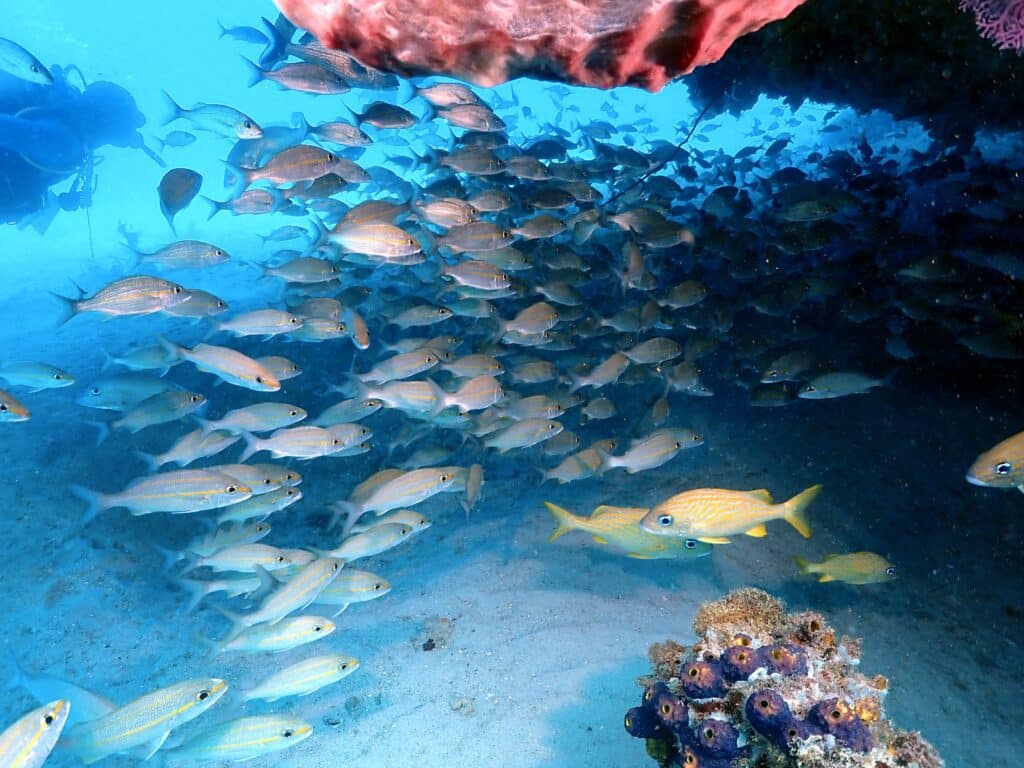
Underwater, the world was quiet again. The reef was busy with life, the kind of gentle swirl of fish and soft movement that makes you forget any chaos happening topside. It was the calmest forty-five minutes of the day, and in its own way, it helped settle my nerves. By the time we surfaced, I could feel my confidence creeping back in, the way it does when you push through something more complex than you expected.
Back on the boat, though, the disorganization hadn’t magically fixed itself. There were no clear instructions on where to rinse gear, divers were moving around trying to sort things out on their own, and the whole operation just felt… scattered. I tried not to let it get under my skin, but after the earlier equipment scare, my patience was running thin.
While I was chatting with another diver, the captain returned to ask, again, whether we’d be diving the next day and whether Philip would join. I politely asked for a few minutes to check with him, but two minutes later, he was back, asking the same question. It was almost comical, but it also confirmed what I already felt: this wasn’t the right dive operator for us.
When I got home, I told Philip everything. The good, the bad, the stressful, and the parts that made me proud of myself. I also told him that, for safety and sanity, we really should consider diving with someone else. He was eager to get back in the water and see if his ankle would cooperate, but even he agreed that maybe we needed a better plan.
What Comes Next in Our Scuba Diving Travel Story
By the time we settled in that evening, I realized just how much had happened in a single day, more than enough for a whole chapter in any scuba diving travel story. A sprained ankle, my first dives without my partner of 30 years, an equipment scare, a long surface swim, and then one of the calmest underwater moments I’ve ever had. Travel has a funny way of throwing chaos and clarity at you in the same breath.
But even with all the ups and downs, I could feel something shift inside me. I had gone diving on my own for the very first time, handled a real underwater emergency, kept my composure, and still managed to enjoy the ocean on that last dive. It wasn’t the day we planned, far from it, but it was the day we got, and it taught me a lot about myself and about rolling with the unexpected.
As for Philip, he was already talking about testing his ankle and seeing if he could join the next day’s dives. I wasn’t so sure the dive operation was the right fit for us, but we decided to play it by ear and see how things unfolded. After all, travel isn’t just about the perfect days; it’s about the stories you end up telling later.
Looking back on that trip, I’m still surprised at how a simple morning of beachcombing in St. Vincent turned into one of the most memorable twists (pun intended) in our scuba diving travel story. What started as a sprained ankle and a sudden change of plans became a day of unexpected challenges, a few lessons, and more than one moment of quiet pride. Travel has a way of reshaping you when you least expect it, and this time, it nudged me into discovering a confidence I didn’t know I had.
These experiences stay with you, the good ones, the stressful ones, and especially the ones that make you rethink what you’re capable of. A year earlier, I had completed my PADI Rescue Diver certification (thank you, Angie!), and I didn’t realize just how much that training had settled into my bones until this trip. All those self-rescue drills, managing stress underwater, recognizing equipment issues, and staying calm when things got loud or confusing showed up when I needed them most. I didn’t plan on handling an equipment failure mid‑dive, but that training helped everything click into place, even when the day felt messy. It’s a reminder that even the most chaotic travel moments can reveal how prepared you genuinely are, wrapped in frustration and saltwater.
If you’ve ever had a trip take a wild turn or faced something unexpected on the road (or underwater), I’d love to hear your story. Join the conversation below and share your own surprising moments. And if you enjoy following along with our adventures, from calm reefs to chaotic surface swims, don’t forget to sign up for our newsletter so you can travel with us wherever we go next.
